


TCDD Taşımacılık will operate the passenger trains which are being subsidized to serve the public interest for another ten years .
Every day in Turkey, 75,000 passengers travel on intercity routes in 55 cities by train. Approximately one-third of these journeys are on high-speed trains, while nearly half are on regional trains operating over short distances. All these trains are operated by TCDD Taşımacılık. The revenue from passenger trains does not cover their expenses, so these trains, deemed to serve the public interest, are subsidized to cover the operator’s losses and even generate a small profit.
It was previously announced that after liberalization, the private opearators could also operate these trains and benefit from subsidies, with initial indications set for 2021 and later 2023. However, it was recently decided that TCDD Taşımacılık would continue to operate all these lines until 2033. Most probably, this decision was taken also due to the fact that private companies showed no interest in the passenger side.
Why is so? Why private operators had started in freight, but nothing seen in passenger side despite subsidies and increasing popularity of high-speed trains worldwide?
Demand is not low
Official statistics regarding the occupancy rates of trains are unfortunately not available. However, it’s quite challenging to find tickets on high-speed trains, and it’s known that some regional trains run full with many passengers standing, and some popular overnight routes quickly sold out. This suggests that demand, particularly on certain routes, exceeds the existing capacity. On the other hand, price sensitivity is quite high on demand, and number of empty seats sharply increased after last price update.
Train stations are often located in much more central locations in many cities compared to airports and bus terminals. This factor reduces total travel time and increases the attractiveness of trains. Moreover, train ticket prices are often lower than bus fares, which is another significant draw.
Room for differentiation
Passenger trains offer more room for creating added value compared to freight trains. There are various options for different services and pricing in this sector, such as departure times, speed, comfort, and dining. Unlike freight trains, where competition is mostly based on price, passenger trains offer opportunities for differentiation.
Only one attempt so far
Despite these advantages and some state guarantees, the private sector has not ventured into passenger trains. So far, there has been only one such attempt, the Cappadocia Express, which was planned to operate between Istanbul and Kayseri. However, it seems that this project has also been shelved.
Why is the private sector not showing interest in this field? Here are some possible reasons:
Limited train access
The railway network in Turkey passes through only 34 city centers. Many coastal areas, which play a significant role in both tourism and internal mobility, have no railway access. Moreover, only a limited number of trips are made from many of the connected cities to distant destinations. Therefore, using connected trips is often impractical unless a new operator launches hundreds of services simultaneously. Otherwise, it will be adversely affected by the scarcity of other trains.
Weak infrastructure
Apart from high-speed train lines, the majority of our network consists of single tracks, which reduces speed and makes it more dependent on other trains. If a train coming from the opposite direction is delayed, it can lead to delays for your train as well. Ground-level crossings on the track also slow down train speeds.
Huge initial investment
Passenger trains not cheap. The price of a high-speed train set can exceed several tens of million euros. If planning a conventional passenger train, locomotive prices start at around 4-5 million euros. Even it is possible to obtain a license with a single set, providing a comprehensive and uninterrupted service needs bigger fleet.
Uncertainties
The single-track nature of Turkey’s railway infrastructure and the widespread nature of renewal and electrification projects often lead to track restrictions. This can mean delays in initial plans. Some railway renewal/electrification projects have taken much longer than initially predicted.
Lack of market knowledge
There are many unknowns when it comes to passenger trains. Information such as the number of passengers or the occupancy rates on each route is either difficult or impossible to obtain for newcomers to this sector. There is no benchmark for maintenance, personnel, and other costs in Turkey.
Low income
The distance between Ankara and Istanbul is approximately 550 km, and the economy class ticket for the high-speed train is around 15 euros. Trains for a similar distance between Berlin and Munich start at 75 euros. Similarly, trains for a similar distance between Rome and Milan start at 115 euros.
In Turkey, intense competition among buses and TCDD Transportation’s efforts to keep train fares at an affordable level relative to purchasing power make train fares cheaper compared to Europe. However, the costs for essential items are often similar.
While subsidies may help covering this gap, those will be only for limited number of trips for specified routes.
Limited labor market
There are actually a reasonable number of experienced personnel in the railway sector, but the majority are employed within TCDD Taşımacılık. It’s not easy for employees to leave their secure positions at a state company and move to a newly established company with an uncertain future and risks. In fact, the two private operators in the freight sector initially could recruit only retired TCDD employees.
While it has been possible to hire personnel from abroad in areas such as aviation, railway spects are quite local, which makes this choice almost impossible.
Industry is unfamiliar with railways
Except for a few exceptions, passenger transportation in Turkey is mainly by air and buses. The private sector’s knowledge, expertise, and experience primarily lie in these two areas. Executives of this area have no experience in the railway sector.
Cover photo: Onur Uysal ©
Categories: Passenger
 Rail Turkey En
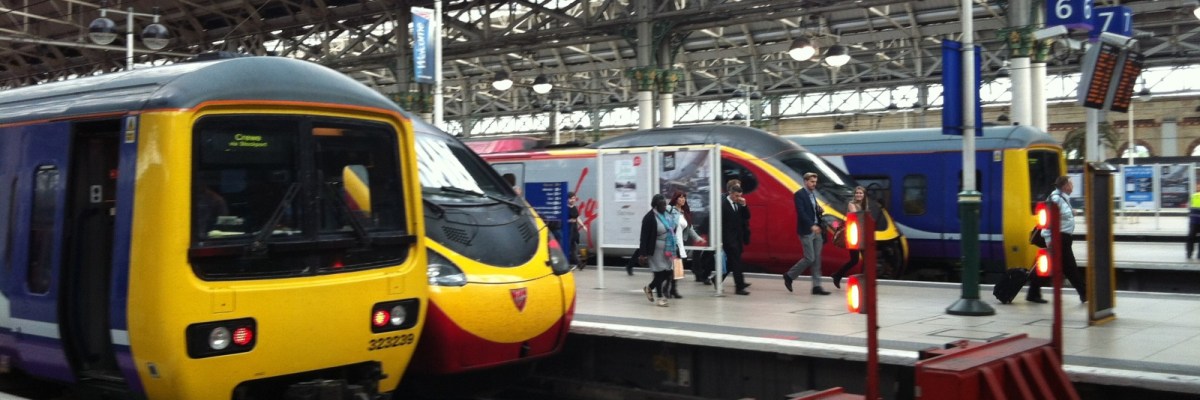
Many thanks, Onur, for your interesting article on this subject. Your opening photograph (taken at Manchester Piccadilly) reminds us that although the private sector has been heavily involved in the running of the passenger trains in the UK since the 1993 Railways Act, the first operators were able to lease trains from the so-called ROSCOs (Porterbook, etc.) without competing with the former British Rail, which disappeared during ‘privatization and therefore had no need of those trains which it had formerly (in some cases) built, and operated. An interesting topic. SAs they say, ‘Watch this space’.
I was expecting more interest in passenger than freight, but it seems we’ll wait long to see the first private passenger train. Would be interesting to reflect what happened in UK, though the market, transportation network and habits are totally different.
It will be interesting to see what happens in the future. A country that interests me is Sweden, which has gone down the road of franchising in the past (like the UK) but where SJ is still a major player, unlike BR which has gone!