


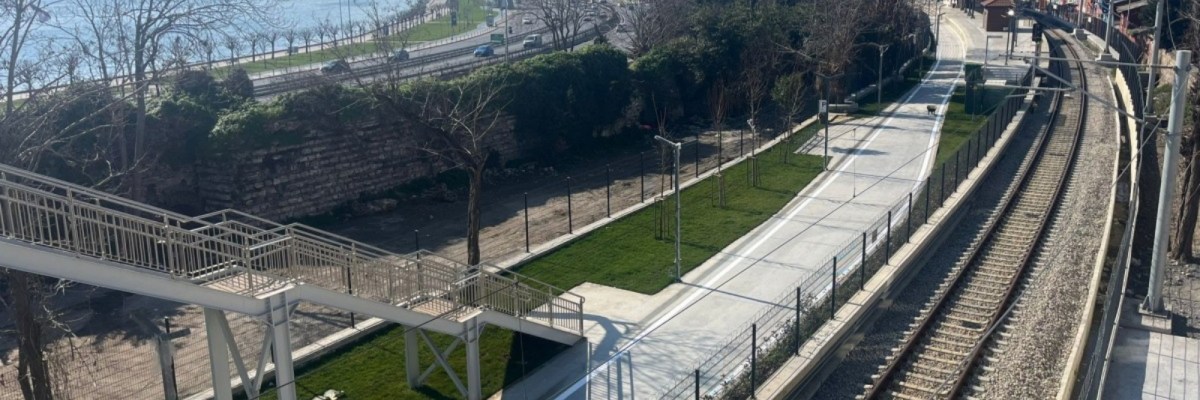
Despite the warming weather, the demand for the Sirkeci-Kazlıçeşme rail system line and the walking/cycling path, which were inaugurated in February, remains very limited.
The Kazlıçeşme-Sirkeci section of the old suburban line, which became obsolete when Marmaray moved underground in Kazlıçeşme, was reopened in February this year as a “new generation transportation project.” As part of the project, a suburban train that stops at 8 stations along the 8 km Sirkeci-Yenikapı-Kazlıçeşme route operates every 20 minutes, while one of the two tracks was removed and replaced with a 7 km long walking and cycling path.
However, despite the warming weather and increased activity in the area, neither the train nor the walking and cycling path have seen much use. The primary reason for this is the low residential density along the coastal area of the historical peninsula through which the route passes. Nevertheless, it was expected that this project would not remain “deserted,” especially on weekends when the coasts are crowded. Here are a few reasons that may be affecting the demand:
Few stations
The stop intervals on the Sirkeci-Kazlıçeşme line are generally 1 km. The distance between Kumkapı and Cankurtaran approaches 2 km. For example, the stop intervals on the T1 tram, which also passes through the historical peninsula, are between 340-400 meters. The lack of stations in the busy areas of Kadırga and Küçük Ayasofya, which are full of schools, hotels, and commercial spaces, is a significant loss.
Not practical
Since the project largely adhered to the structure of the old suburban train stations, it was not possible to design boarding the train with the practicality of a tram. One needs to go down from street level and then go up to the platform. While this may not be an issue for long-distance journeys, it can make the train seem “not worth it” for those who want to travel short distances. The T1 tram is a very successful example in this regard.
Infrequent service
Trains run every 20 minutes. For comparison, this interval is 8 minutes on Marmaray and 2 minutes on the T1 tram. The length of the trains, the single track, and the long distance between stations may prevent more frequent service.
Isolated
Placing the walking/cycling path on the coastal road side rather than the city side has significantly disconnected the project from urban life. The walking/cycling path is entirely separated from the city by the train line, which is fenced on both sides, and can only be accessed from the locations where the stations are. It is not possible to enter the walking path from anywhere between two stations and reach the station. Walking path is mostly not prefered by those who want to walk from one neighborhood to another though the alternative is narrow sidewalks often occupied by cars or shops.
Oppressive
The pedestrian and cycling path is fenced on both sides. Once you enter from a station, there is no other exit for 1-2 km. There is no place to sit or get water. To enter the walking path, you first need to go under the train track from the street, go up to the platform, and then descend to the walking path. If you see something of interest on the other side of the fence while walking, you need to walk to the nearest station, exit, and walk back the same distance on the sidewalk.
Cover photo: TCDD Taşımacılık ©
Categories: Urban Transport
 Rail Turkey En
Not sure if you are aware, but the VSOE (Orient Express) from Paris to Istanbul is arriving at the Sirkeci station today, June 5th, at 15:18 o’clock. It’s going to be the first long distance/sleeper train after over 10 years, terminating at Sirkeci again. Might be a good opportunity to shoot photos/videos for anyone who can make it there on time.
In regards to the U3/T6, I am not surprised it isn’t more popular. The line shouldn’t be called or compared with trams. It’s an extension of the Marmaray, using the same rolling stock, same station spacing, layout etc. For this line to thrive, the frequency needs to be at least 10 min, and it needs to be extended to Bakirköy YHT station. Both could already easily be implemented today, as there are enough passing tracks, and the 3rd (almost dormant) surface track goes to Bakirköy and beyond.
When I saw the news item on the opening of this new service I was very surprised. I had assumed that it was going to be a tram service not a ‘heavy rail’ line using ‘Marmaray’ stock. I’m sure that initial discussions on this project had referred to a ‘tramway’. Presumably, though, the use of ‘Marmaray’ trains makes it easier for the operators because the trains are simply supplied from an existing fleet and maintained as part of that fleet. I’m not surprised that the service has been, so far, a disappointment.
For me train service parts is a little surprise. But I am really shocked how the walking lane is so irritating. A successful one would increase the attractivity of the train as well.
Hello, interesting analysis and sad to see the result.
and I imagine we have still no news at all about the possibility of having an arrival/departure of the Sofia train at Sirkeci instead of Halkali?
I see no reason not to, but yet no news about Sofia Express departing from Sirkeci.